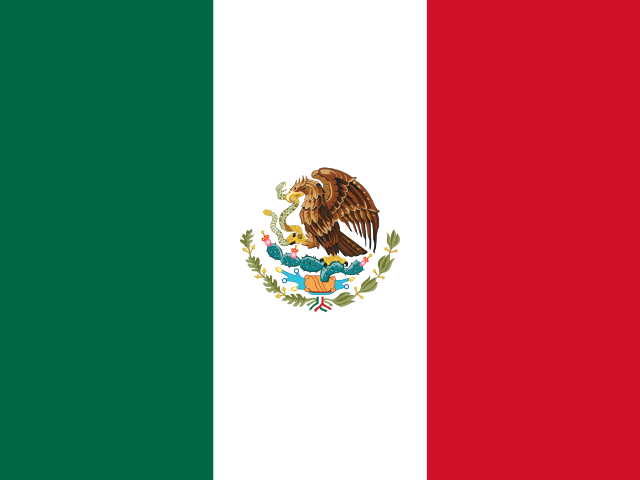
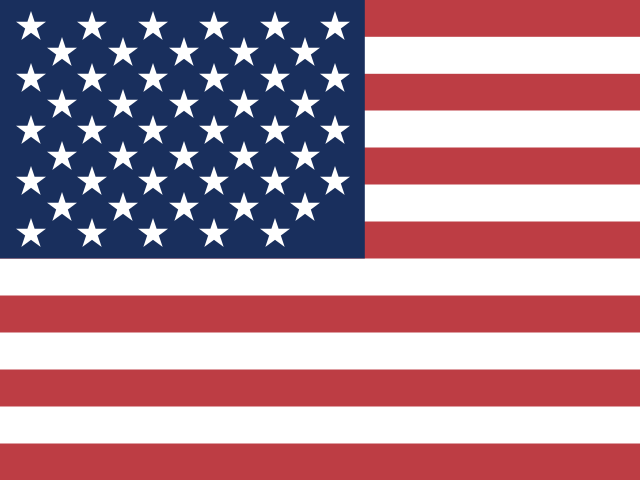




The rules to scatter ashes at sea depend entirely on whose waters you are in. In the United States the Environmental Protection Agency sets a clear standard: cremated remains must be released at least three nautical miles from land, and the EPA must be notified within thirty days. Mexico works differently, and that difference is the source of most of the confusion families run into.
This guide sets both frameworks side by side, with each one cited. It is written to help a decision, not to hurry one.
Can you scatter ashes at sea in U.S. waters?
The EPA regulates this under its ocean dumping program. Its Burial at Sea guidance states that cremated remains may be buried in ocean waters of any depth provided it takes place at least three nautical miles from land. There is no minimum depth requirement for cremated remains, unlike uncremated ones.
Two further points matter in practice. First, the family must notify the EPA within thirty days of the event, which can be done through the agency’s online reporting tool. Second, the EPA explicitly prohibits releasing materials that do not readily decompose, naming plastic or metal flowers and wreaths, tombs and tombstones.
The rules in Mexican waters
Mexico has no law that specifically regulates scattering human ashes. The statute governing what may be released into Mexican marine waters is the Ley de Vertimientos en las Zonas Marinas Mexicanas, published in January 2014, and the Secretaría de Marina is the authority under its articles 1 and 5.
That law lists the materials covered by a dumping permit in its article 11: dredging material, uncontaminated natural organic material, fish waste, vessels, platforms, geological materials, iron, steel, concrete and sewage sludge. Human ashes appear nowhere in that list, and the words for ashes, human remains and cremation do not appear anywhere in the text.
And here is where the confusion comes from. The three-nautical-mile figure that circulates widely in Spanish-language articles about Mexico is the U.S. EPA rule, not a Mexican one. Mexican law sets no such distance for ashes. In practice, then, the right step is to confirm local conditions with the port captain at your destination.
How much does it cost to scatter ashes at sea
The cost is essentially the cost of chartering a boat privately for a few hours, because the ceremony itself has no fee attached. Three things move that number:
- The vessel. A small sailboat for a handful of people sits at the low end; a larger motor yacht for an extended family sits well above it.
- The duration. Most families need a short outing, which is the shortest block a charter offers.
- The destination. Rates vary between the Caribbean and Pacific coasts and by season.
We do not publish a fixed figure for this service, because quoting one without knowing the vessel and destination would be misleading. Current rates by boat are listed in our yacht rentals in Mexico catalog, and you are welcome to ask us directly.

What may be released into the water
Both frameworks agree on the principle: only what the sea can absorb.
- Yes: the ashes themselves, loose natural flowers, and biodegradable urns made of salt, pressed paper or plant fiber.
- No: ceramic, metal or plastic urns, bags, cellophane, ribbons, balloons and floating candles.
If you want to understand the process that comes before, the Wikipedia entry on cremation explains what it involves and what remains afterwards.
What the ceremony aboard is like
There is no single format, and that is perhaps the most important part. Each family sets the tone.
The usual shape is a short sail to a quiet spot where the captain brings the boat to a stop. There are often a few words, sometimes music, and then the moment itself. Many families bring loose flowers, without wrapping or ribbon.
It is done on a private boat rather than a shared tour, because the moment calls for no strangers aboard. A few things families are glad to know beforehand: the wind decides which side of the boat is used, mornings are usually calmer than afternoons, and it is prudent to carry the cremation certificate in case the authority asks for it.
Scatter ashes at sea FAQ
Is it legal to scatter ashes at sea in Mexico?
Mexican law does not mention human ashes, so there is no express prohibition and no express authorization either. Confirm conditions with the port captain at your destination.
Does the three-nautical-mile rule apply in Mexico?
That figure comes from U.S. EPA regulation and applies to United States waters. It is not part of Mexican law, although it is widely repeated as if it were.
Do we need to notify anyone?
In U.S. waters, yes: the EPA within thirty days. In Mexico there is no equivalent notification specific to ashes, which is why confirming locally matters.
How many people can come aboard?
It depends on the vessel and on the rules of its departure port. The authorized capacity appears on each boat’s listing.
How we can help
We operate private boats in ten destinations across Mexico. If you are considering a ceremony of this kind, write to us and we will tell you what is available at your destination and what is worth confirming with the port authority.
- WhatsApp: +52 669 1 32 4073
- Email: ayuda@yatezzitos.com
- Available boats: yacht rentals in Mexico
If you would rather just ask questions first, that is fine too.
This guide cites U.S. EPA burial-at-sea guidance and the Ley de Vertimientos en las Zonas Marinas Mexicanas (published 17 January 2014) for information only, and is not legal advice. Applicable conditions are determined by the relevant maritime authority. Verified August 2026.


Join The Discussion